
Install WordPress Pete on Google Cloud (Production)
1 — Provision the server
Path: Compute Engine → VM instances → Create instance
Name:
pete-prodRegion/Zone: nearest to your users
Machine type: e2-standard-2 (2 vCPU, 8 GB) to start
Boot disk: Ubuntu 24.04 LTS
(Change → OS: Ubuntu → Version: 24.04 LTS → Select)Firewall: check Allow HTTP and Allow HTTPS
Click Create.
2) Reserve & Attach a Static External IP
(Prevents DNS changes when the VM reboots)
Reserve:
VPC network → IP addresses → Reserve external static IP address
Type: Regional, Version: IPv4
Name:
pete-prod-ipRegion: same as your VM
Assign:
Compute Engine → VM instances → pete-prod → Edit → Network interfaces
External IP: select
pete-prod-ip
Click Save.
3) Open Required Ports (if you didn’t tick HTTP/HTTPS)
Path: VPC network → Firewall rules → Create firewall rule
Name:
allow-webDirection: Ingress
Targets: All instances in the network (or restrict via tags)
Source IPv4 ranges:
0.0.0.0/0Protocols/ports:
tcp:80,443,22
Create the rule.
Tip: After you finish setup, consider restricting SSH (
22/tcp) to your office IPs.
4) (Recommended) Enable OS Login for SSH
Why: IAM-based SSH access (easier user management, revocation, and 2FA).
Project-wide:
Compute Engine → Metadata → Edit → Add item
Key:
enable-osloginValue:
TRUE
Save.
Per-VM (alternative):
Compute Engine → VM instances → pete-prod → Edit → Metadata → Add item
Key:
enable-osloginValue:
TRUE
Save.
Also assign your user the IAM role Compute OS Login (or Compute OS Admin Login).
Security best practice: Prefer OS Login or IAP tunneling instead of leaving SSH open to the internet.
2 — Connect over SSH
From your local terminal, replace <PUBLIC_SERVER_IP> with the server’s address and connect as root:
3 — Run the Pete installer
ssh root@<PUBLIC_SERVER_IP>Paste the one-liner below into the SSH session; it downloads, makes executable, and launches the installer:
curl -o pete_installer.sh -L https://deploypete.com/pete_installer.sh && chmod 755 pete_installer.sh && sudo ./pete_installer.sh4. Launch Pete in your browser
When the script completes, simply visit:
http://<YOUR_SERVER_IP>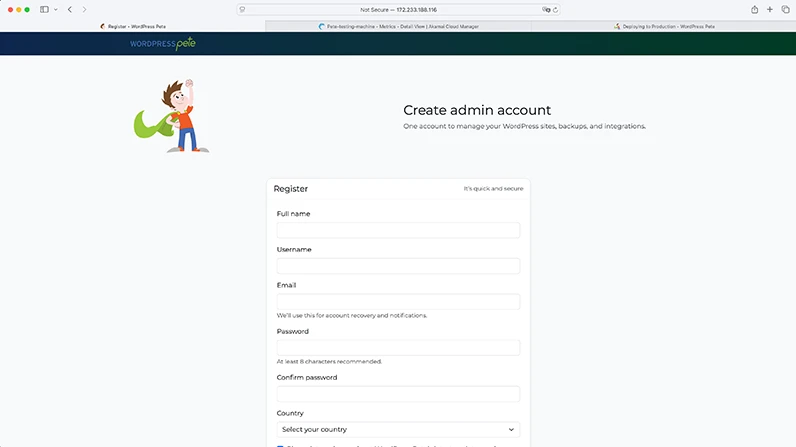
5. (Optional — Recommended) Harden SSH & Firewall
Still connected as root, tighten basic security in one sweep
# ── Change SSH to a non-standard port (2222) ──
sed -i 's/^#\?Port .*/Port 2222/' /etc/ssh/sshd_config
systemctl restart ssh
# ── Refresh UFW rules ──
# drop old SSH port
ufw delete limit 22/tcp
# rate-limited new SSH port
ufw limit 2222/tcp
# Allow HTTP
ufw allow 80/tcp
# Allow HTTPS
ufw allow 443/tcp
ufw --force enable
Next time you connect:
ssh -p 2222 root@<YOUR_SERVER_IP>System Passwords & Environment Variables
All secrets generated during installation—database credentials, API keys, reload tokens, etc.—live in /opt/wordpress-pete/.env
# View the file (read-only)<br />
sudo cat /opt/wordpress-pete/.env
Switching WordPress Pete to a Different PHP Version — Zero Downtime
1. Edit the version flag
Keep it safe
This file is the single source of truth for every password and token in your stack—treat it like a vault key.
Restrict access:
chmod 600 /opt/wordpress-pete/.env(owner-read/write only).Never commit it to version control or share it in support tickets.
sudo vim /opt/wordpress-pete/.envFind PHP_VERSION= and set it to 8.1, 8.2, or 8.3. Save & exit.
2. Re-build the PHP image
docker compose build --no-cache php3. Hot-swap the container
Launch the freshly built PHP container (no other services are touched)
docker compose up -d php4. Verify
Sign back in to WordPress Pete and visit /admin/phpinfo to confirm the new PHP version is active.
Docker Compose Cheat-Sheet
| Task | Command (inside your project folder) | When / Why you use it |
|---|---|---|
| WordPress Pete Docker project route | cd /opt/wordpress-pete | Browse to the project dir |
| Start or re-build the stack |
docker compose pull docker compose build docker compose up -d | Builds images if they changed and launches every service in the foreground. Hit Ctrl +C to stop. |
| Open a shell in a container |
| Inspect logs, run WP-CLI / Artisan, edit files quickly. |
| Re-build after editing a Dockerfile | docker compose build --no-cache apachedocker compose build --no-cache phpdocker compose build --no-cache mysql | Forces a clean image rebuild for wordpress, apache, or php after you tweak their Dockerfile. |
| Delete all volumes (nuke-and-pave) | bash docker compose down -v | Stops containers and removes every named/anonymous volume—irreversible. |
| Restart Apache inside its container | bash docker compose exec apache bash -c "apache2ctl restart" | Applies v-host changes without recreating the whole stack. |
| Where Apache keeps v-hosts | /etc/apache2/sites-available – staging configs /etc/apache2/sites-enabled – live symlinks | Edit a file in sites-available, then run apache2ctl graceful (from inside the container). |
| Where Apache keeps the website files | /var/www/html | Pete files path: /var/www/html/Pete |
| Enter MySQL as root | docker compose exec mysql -u root -p (password = MYSQL_ROOT_PASSWORD in .env) | Handy for one-off queries or importing .sql dumps. |